There is a powerful difference between cultural expression and ideological domination—a difference that is often lost in the noise of contemporary politics. In India, this contrast is sometimes captured through a symbolic pair of images: raising the saffron flag and lowering the Indian tricolour. At first glance, both gestures seem to involve symbols, but they represent two fundamentally different visions of nationhood. This is not really about flags; it is about what those flags stand for.
The saffron (bhagwa) flag has long been associated with Hindu monastic orders, spiritual traditions, renunciation, and philosophical ideals. When people speak of “raising the bhagwa,” they are usually referring to a cultural metaphor: a reconnecting with civilizational memory, the celebration of a shared heritage, and the revival of philosophical values. In this sense, the saffron flag symbolizes a Hindu Rashtra in its classical, civilizational meaning—a cultural landscape shaped by Hindu ideas but not a state defined or ruled by them. This form of cultural pride can coexist entirely with constitutional nationalism; it does not demand the displacement of the Indian Republic.
The Indian flag, by contrast, represents the Constitution, democratic citizenship, equality before the law, and the idea of India as a pluralistic republic. It is the flag of all Indians, regardless of background or belief. To “lower” it is not a question of cloth or colour—it is the symbolic act of subordinating the Republic to something else. So when someone says, “The goal was not to raise the saffron flag, but to lower the Indian flag,” they are offering a philosophical critique, not describing a literal action. They mean that the aim was not cultural rejuvenation or civilizational pride, but rather an attempt to replace civic nationalism with ideological nationalism.
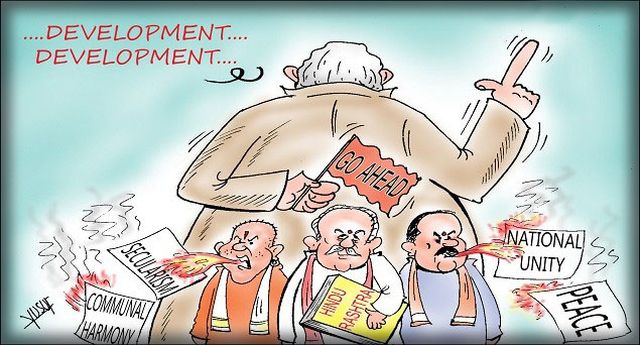
This is the shift from a Hindu Rashtra understood as a cultural metaphor to a Hindutva Rashtra understood as a political project. The first vision can live comfortably alongside the Indian state; the second seeks to reshape or dominate it. A culture rising is not a threat. Cultures can flourish without erasing others and without altering the foundations of democratic citizenship. But when ideology replaces the Constitution, when identity overtakes citizenship, and when symbols of a single tradition seek primacy over the national symbol that binds all traditions, the shift becomes structural, not cultural. It affects how rights are defined, how minorities are viewed, how history is interpreted, and how the nation imagines itself. It moves from expression to imposition.
The central question, then, is not whether the saffron flag is meaningful—it is. The real question is whether the goal is cultural celebration or political supremacy. A civilization does not need to overpower its Republic in order to feel proud. A culture does not need to lower the national flag to rise. When the bhagwa rises alongside the tricolour, it is culture expressing itself. When it rises in place of the tricolour, it is ideology asserting itself. And that difference—subtle in symbolism but profound in consequence—marks the boundary between a cultural Hindu Rashtra and a political Hindutva Rashtra.